Introduction: Why Traditional Purchasing Approaches Are Reaching Their Limits
Most organizations moved away from paper binders years ago. Yet the same old problems simply migrated into spreadsheets, shared trackers, and long email chains. Requisitions sit in inboxes waiting for action. Approvals move across multiple reviewers. And procurement teams often spend more time chasing transactions than strengthening supplier relationships.
With the Oracle Fusion Procurement implementations I have supported, one trend appears repeatedly. Spreadsheet-driven processes usually work fine when transaction volumes are low. But as purchasing activity grows, approval delays, fragmented tracking, and limited visibility quickly become difficult to manage. Organizations that modernize their procure-to-pay processes consistently achieve faster cycle times, stronger controls, and better operational visibility.
Why Are Traditional Purchasing Methods Under Pressure?
Supplier availability, freight costs, and delivery timelines can shift overnight. Manual reviews and multi-layer approval cycles simply cannot keep pace with that kind of change.
Oracle Fusion Cloud Procurement offers a practical path forward. It moves organizations from reactive, manual work toward responsive, rules-based processes while preserving the governance, compliance, and financial controls that matter most.
How Do Oracle Fusion Cloud Procurement Improves Procure-to-Pay?
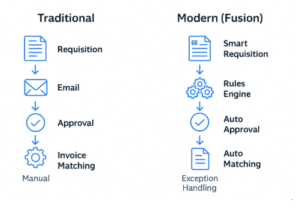
Traditional procure-to-pay cycles frequently feel fragmented. Requisitions wait for approvals, invoice matching stays manual, and information is scattered across departments. Fusion brings these activities together through configurable workflows and native automation, creating a much smoother end-to-end flow.
Rules-Based Routing That Reduces Delays
The moment an employee submits a purchase request, intelligent rules take over:
- Low-value purchases from approved suppliers can move quickly with minimal intervention.
- Higher-value or higher-risk requests route automatically to legal, finance, compliance, or risk teams.
- Budget validations reference available funds, commitments, and configured controls before approvals proceed.
- Existing contracts apply negotiated pricing and terms automatically.
- Supplier qualification activities trigger where required.
- Category and project purchases follow predefined approval hierarchies.
Once approved, purchase orders are generated automatically, accounting entries are created, and suppliers receive notifications. Manual follow-ups largely disappear.
Implementation Snapshot: Manufacturing Procurement Transformation
A large manufacturing group modernized its purchasing operations using Oracle Fusion Procurement with phased automation, approval redesign, and finance integration. The program delivered clear, measurable improvements.
| Metric | Before | After |
| Requisition approval cycle | 4–5 days | < 24 hours |
| Manual follow-up effort | High email dependency | Reduced significantly |
| Spend visibility | Fragmented tracking | Centralized reporting |
Key observations from the project:
- Supplier master cleanup and approval redesign delivered early value.
- Self-service procurement improved user adoption.
- Finance integration reduced reconciliation effort.
The Value of Well-Configured Business Rules
In practice, well-configured rules enforce spend thresholds, supplier qualification requirements, documentation standards, and bidding policies consistently. They reduce exceptions and eliminate much of the manual coordination that used to happen late in the process.
Why User Experience Matters?
When systems feel cumbersome, employees naturally look for workarounds. Better user experiences drive higher adoption, maintain visibility, and support overall compliance.
Self-Service Procurement That Employees Actually Use
Oracle Fusion Self-Service Procurement lets employees browse approved catalogs, compare items, review estimated budget impact, and submit requests without relying on offline approvals. Procurement teams spend less time on routine processing and more time supporting strategic sourcing initiatives.
Approvals Designed Around Real Work Patterns
Managers are rarely at their desks all day. Mobile approvals allow them to review requests, comments, and supporting documents from any device. This single capability helps shorten approval cycles noticeably.
Technology Behind the Automation
Oracle Fusion Cloud includes strong native capabilities for invoice capture, three-way matching, and synchronization across procurement and finance processes. These tools reduce repetitive work and improve consistency at a scale.
Automating Invoice Matching
Purchase orders, receipts, and invoices are matched automatically. Transactions within configured tolerances move forward for invoice processing, while exceptions are routed for review with all supporting information attached.
AI and Analytics in Procurement
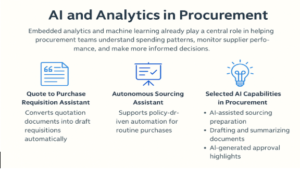
Embedded analytics and machine learning already help procurement teams identify spending trends, monitor supplier performance, and make more informed decisions. Oracle AI Agent Studio extends this by enabling organizations to configure intelligent agents that align with their own data, business rules, and approval structures.
The Autonomous Sourcing Assistant, for example, can support routine sourcing activities by helping create negotiation events, suggest qualified suppliers, consolidate responses, and provide bid analysis insights. While final decisions remain with procurement teams, these capabilities significantly reduce manual effort and improve consistency.
Generative AI features further assistance with creating questionnaires, drafting negotiation summaries, and preparing documentation. In most implementations I’ve seen, organizations begin with focused, well-defined use cases and expand gradually as confidence in automation grows.
Beyond AI agents, Oracle Fusion embeds AI directly into day-to-day procurement activities to reduce effort and improve decision quality.
In practice, organizations are seeing value in areas such as:
- AI-assisted sourcing preparation (requirements, questionnaires, negotiation content)
- Drafting and summarizing procurement documents and approvals
- AI-generated highlights for faster decision-making in approvals
- Supplier recommendations and improved transaction classification
Rather than deploying everything at once, most organizations start with these targeted capabilities and expand gradually as adoption improves.
Connecting Procurement and Finance
One of Fusion’s greatest strengths is how seamlessly procurement and finance work together. Purchase orders, receipts, supplier updates, and budget commitments stay aligned in real time. This reduces reconciliation effort and improves reporting visibility across the business.
Supporting Teams Through Change
Automation is not about replacing procurement teams. It shifts their effort toward higher-value activities such as supplier management, negotiations, risk handling, and strategic alignment. In successful projects, teams gradually move away from transaction chasing and spend more time managing relationships that truly drive value.
Building the Right Data Foundation
Supplier master cleanup, category alignment, approval of hierarchy validation, and contract reviews are usually the first steps before enabling broader automation. Clean data remains one of the biggest contributors to long-term implementation success.
What Procurement Teams Are Seeing Today ?
Organizations using these Oracle Fusion capabilities are reporting shorter procure-to-pay cycles, stronger contract compliance, improved spend visibility, and higher user adoption. Capabilities such as self-service catalogs, workflow approvals, mobile access, automated matching, intelligent sourcing tools, AI support, and tight finance integration are already available today within Oracle Fusion Cloud Procurement.
If you are evaluating ways to improve your purchasing operations, the team at Orbrick can help assess your current processes and identify the next practical steps based on real implementation experience.

A Senior SCM Consultant with deep expertise in Oracle Fusion Cloud Procurement and supply chain transformation
Stay Ahead with ERP & AI Insights
Actionable insights on ERP, AI and business solutions, straight to your inbox each month.
Subscribe for InsightsRecent Posts





Categories
Latest News

Website Launch And 3 Lessons From Chandrayan-3
January 16, 2024


Real Time Visibility In Supply Chain
January 16, 2024