In today’s industrial landscape, maintenance has grown into more than just a support function. It directly impacts uptime, revenue protection, regulatory compliance, and customer experience.
For asset-intensive industries like utilities, district cooling, telecom, infrastructure, and manufacturing, unplanned downtime is never just a technical issue; it’s a financial event.
At Orbrick, we believe maintenance transformation goes beyond simply implementing software. It’s about architecting intelligent ecosystems powered by a modern maintenance management system that enable:
- Real-time decision-making
- Predictive insights
- Operational resilience
- Financial optimization
Through a recent Oracle Fusion maintenance implementation, integrated with a custom application built on Oracle Visual Builder Cloud Service (VBCS), we helped a large asset-driven enterprise move from reactive firefighting to intelligent, AI-enabled, and financially optimized maintenance operations.
The Ground Reality: What Traditional Maintenance Struggles With?
The technology existed, but the adoption did not.
Before the transformation, the organization faced common yet critical challenges that many legacy maintenance management systems struggle to solve.
- Fragmented Work Intake:
Work requests came through emails, spreadsheets, calls, and legacy tools.
Result:
- Lost or duplicate work orders
- Delayed approvals
- No centralized visibility
- Reactive Maintenance Culture:
Without structured preventive frameworks or predictive maintenance solutions:
- Assets failed unexpectedly
- Emergency repairs increased
- Spare parts planning was inconsistent
- Limited ExecutiveVisibility:
Leadership lacked:
- Live dashboards
- SLA monitoring
- Cost transparency
- Poor Field UserExperience:
Technicians struggled with:
- Complex ERP screens
- Non-mobile-friendly interfaces
- Slow transaction entry
Oracle Fusion Maintenance: The Digital Backbone
Oracle Fusion Maintenance provided a powerful cloud-native foundation for enterprise management.
Key capabilities included:
- Asset hierarchy and classification
- Preventive and corrective work orders
- Inventory and spare parts integration
- Cost capture and financial traceability
- SLA tracking and reporting
However, as we moved deeper into the implementation, an important design consideration emerged
Building a Lightweight Operational Layer on Top of Oracle Fusion
In large maintenance driven organizations, thousands of operational users interact with enterprise systems as part of their daily activities. While Oracle Fusion Cloud provides a comprehensive and robust ERP environment, many field users typically perform a smaller set of operational tasks such as raising work requests, updating task status, logging time, and recording material usage.
This prompted an important design consideration “how can organizations provide a simplified operational experience for field teams while ensuring that the ERP platform continues to function as the system of record?”
Rather than approaching this purely from a system access perspective, the solution was to introduce a lightweight operational layer built using Oracle Visual Builder Cloud Service, designed in alignment with Oracle Redwood UX principles. This layer complements the ERP by delivering a focused interface tailored for day-to-day maintenance operations. During implementation, this approach enabled several capabilities that are not always easily achievable through standard seeded ERP screens, such as:
- Simplified role-based interfaces tailored for technicians, supervisors, and external operational teams
- Mobile-friendly task execution flows enabling faster updates from plant locations or field environments
- Unified operational dashboards combining work requests, task queues, alerts, and maintenance insights in one view
- Custom approval flows aligned with organizational maintenance governance
- Guided workflows and contextual forms that streamline activities like work request submission and status updates
- Cross-department visibility allowing multiple operational teams to collaborate within a single interface
- Flexible UI layouts and validations designed around real operational processes rather than generic ERP screens
The intent was not to replace ERP functionality, but to extend it thoughtfully allowing Oracle Fusion Cloud to remain the enterprise system of record, while the VBCS application delivers a focused, Redwood-based operational experience for field users. This architecture helps organizations balance usability, scalability, and operational efficiency, while maintaining strong enterprise governance.
This architectural approach also became the foundation for the Orbrick design philosophy favouring extensions over core ERP customization.
The Orbrick Strategy: Extension Over Customization
Instead of customizing the ERP core, we adopted an extension-first architecture. A centralized, role-based Custom Maintenance Application was built using Oracle Visual Builder Cloud Service (VBCS) and designed in alignment with Oracle Redwood UX principles to deliver a modern and intuitive operational experience. In this model, Oracle Fusion Cloud continues to function as the system of record, while the VBCS application serves as the operational interface for day-to-day maintenance activities used by technicians, supervisors, and cross-department teams.
Key principles of the approach:
- ERP as the Source ofTruth : Core enterprise data such as assets, locations, work orders, and reference masters continues to reside in Oracle Fusion, ensuring governance, traceability, and compliance.
- Redwood-Based OperationalExperience : The application follows Redwood UX design standards to provide a consistent, simplified, and mobile-friendly interface aligned with modern Oracle applications.
- Replication & Synchronization withFusion : Operational data used in Redwood-based screens is replicated from Oracle Fusion and periodically synchronized, ensuring users work with updated information while maintaining ERP data integrity.
- Focused OperationalAccess : Field technicians and operational users interact through the VBCS interface for activities such as raising work requests, updating status, logging time, submitting approvals, and tracking tasks, while ERP continues to support core enterprise processes.
- Streamlined UserInteraction :The application is designed to reduce the number of clicks required for common maintenance activities, enabling technicians to complete operational tasks more quickly and efficiently.
- Context-BasedValidations :User-defined validations at the page level ensure that required operational information is captured accurately before transactions are submitted, supporting data quality and process consistency.
The result is a clean architectural separation where Oracle Fusion Cloud remains the enterprise backbone and the Redwood-based VBCS layer provides a scalable and user-friendly operational platform aligned with real maintenance workflows used during the implementation project.
Before:
- All technicians + supervisors → Full Oracle Fusion licenses
After:
- Core SCM & planning team → Oracle Fusion licenses
- Field users → Custom VBCS Maintenance App
- The approach also contributed to more efficient system utilization and scalable user enablement, allowing operational teams to interact with the maintenance platform in a streamlined way while keeping core enterprise controls within Oracle Fusion Cloud. From a leadership perspective, this supported better resource optimization and long-term platform sustainability, while maintaining enterprise-grade governance, security, and operational visibility. Beyond architecture and platform design, significant focus was placed on ensuring a stable and reliable go-live during the implementation project. Before deployment, the application underwent extensive functional validation, cross-department testing, and operational scenario simulations to ensure a smooth rollout and a bug-free application go-live.
- Key activities included:
- Comprehensive User Acceptance Testing (UAT) with maintenance teams, supervisors, and operational stakeholders.
- End-to-end process validation covering work request creation, approvals, asset tracking, and reporting workflows.
- Performance and usability testing to ensure the application handled real operational workloads efficiently.
- Data replication and synchronization validation between Oracle Fusion Cloud and Oracle Visual Builder Cloud Service to maintain data accuracy.
- User training sessions and controlled rollout planning to ensure smooth adoption across departments.
- As a result, the solution achieved a stable and seamless go-live, with minimal operational disruption and strong user confidence from the first day of production use.
Real-Time Operational Examples:
- Plant Equipment Maintenance Report
In daily plant operations, technicians can quickly raise a work request through the VBCS application when an issue is observed in equipment such as pumps, chillers, or valves. The request is submitted through the Redwood-based interface and automatically synchronized with Oracle Fusion Cloud, where supervisors review, approve, and convert it into a work order for maintenance execution.
- Field Technician Task Updates and Time Logging
During preventive or corrective maintenance activities, technicians update task status, log work hours, and record material usage directly through the VBCS interface on site. The application then synchronizes these updates with Oracle Fusion Cloud, ensuring that maintenance history, asset performance data, and reporting remain accurate and up to date.
- Traditionally, preventive maintenance activities were scheduled at fixed intervals, such as every 90 days, regardless of the actual operating condition of the asset. While this ensured regular inspection, it sometimes resulted in maintenance being performed even when equipment was functioning optimally. With improved data visibility and integration within Oracle Fusion Cloud, historical maintenance records, meter readings, and asset performance data can be analysed more effectively. This enables maintenance teams to make better-informed decisions on when intervention is truly required, rather than relying solely on static schedules.
Together, these operational scenarios demonstrate how the solution supports practical day-to-day maintenance activities, while maintaining the reliability and governance of the enterprise ERP platform.
Hybrid Architecture Overview
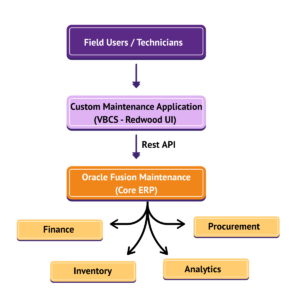
This hybrid architecture ensured that operational simplicity for field users could coexist with enterprise-grade financial and asset governance inside the Oracle Fusion maintenance architecture.
Operational Outcomes Observed:
- Reduction in unnecessary preventive maintenance activities
- Improved asset availability and operational uptime
- Better alignment between spare parts usage and actual maintenance needs
- More balanced allocation of maintenance workforce
Impact:
- 30–40% reduction in unnecessary preventive jobs
- 20–30% improvement in uptime
- Reduced spare part overstocking
- Optimized labour allocation
Maintenance shifted from calendar-driven to intelligence-driven.
Measurable Outcomes Delivered
| Outcome | Business Impact |
| Reduced Asset Downtime | Higher service reliability |
| Higher Preventive Ratio | Lower emergency cost |
| Improved Productivity | Faster job closure |
| Real-Time Visibility | Proactive decision-making |
| License Cost Optimization | Controlled subscription growth |
| AI-Ready Framework | Future predictive scalability |
Vishwa Desai’s career journey spans 10+ years across diverse industries, where I’ve worked at the intersection of people, processes, and technology. Over time, my focus has evolved toward Supply Chain Management and Oracle Fusion Cloud ERP, particularly in areas like Procurement, sourcing, supplier collaboration, and Procure-to-Pay operations.
Recent Posts

 Design Office