The Oracle Redwood Saga: Upcoming Updates in Responsive Self Service Procurement UI

Oracle Redwood has been gaining attention due to its recent updates and announcements. The Redwood theme is designed to provide a high-quality user experience to its users. As per Oracle, “The idea is to transform the whole company’s communication and its vast portfolio of technologies and applications to share a common vision and user experience.”

Many of you might ask: “What’s the need? We’re accustomed to the classic UI/UX, and it does the job very well. So, why go through such a significant change?”

A simple explanation would be that when you compare the UI/UX and animations of modern web pages, Oracle Fusion Cloud might come off as a bit outdated. Even when compared to its newer competitors, the design may seem less attractive at first. The user interface becomes more challenging to navigate. And last but not least, the current pages aren’t responsive on devices like mobile phones or tablets. In today’s world, where we’re used to doing everything at our fingertips, this might seem like a turn-off.

But don’t worry; Redwood has you covered. It has an eye-catching modern design. It also has a responsive UI and module-specific apps. Mobile devices run them without a hitch.

Now, many of you might be thinking, “So, is it all about user experience and theme?” The simple answer is ‘NO.’ It goes beyond that and certainly brings a lot more features as well. Oracle has definitely seized the opportunity to enhance features wherever possible. In this blog, we’re listing down some of the key features, with a focus on ‘self-service procurement.’

  1. Secure the catalog by delivering it to locations.’
  2. Procure goods from preferred sources during catalog shopping (applicable for supplier-sourced as well as internal transfer requisitions).
  3. Bill-only requisitions and other requisitions requiring special handling.
  4. A dedicated field is for extra supplier contact emails. It ensures that further communication to the supplier will also go to the extra contact.
  5. It provides a powerful, smart new search experience. For example, you can search for items by the manufacturer or supplier part number mentioned in the item master.
  6. Enhanced Requisitions Status, which goes beyond ‘approved’ status. Many new statuses, such as Action Required (for invoice hold), Ordered, Shipped, In Receiving, Billed, Order on Hold, etc., are being introduced.
  7. View the current requisition approver and the refined approval tree view of all the approvers.

The above features offer just a brief overview of what Oracle has recently announced. Many more features have already been announced or are expected to be announced in the coming months.

Important Announcement:

If you haven’t heard, the classic requisition UI is being retired starting from update 25A and will be replaced by the Redwood-themed Responsive Requisition UI. An approximate timeline for the retirement of the classic UI would be 7-8 months from today. Now is the perfect time to start planning the transition to the RSSP.

Beyond Buzzwords : Elevating A Digital transformation Exercise

In today’s fast-moving digital world, no company can afford to miss the bus of digital transformation. With rapidly moving market, existence of businesses comes into question if they fail to digitally transform themselves to compete and capture new markets. But as the world is rapidly moving towards digital transformation, with the constraints of resources are they getting the expected outcome/ROI? Are they able to make the required impact on all the stakeholders?

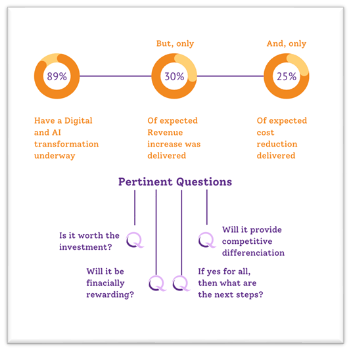
The above study by McKinsey’s digital practice clearly states that although 89% of the business are or have undergone business transformation and as an end result only 30% of them got the expected revenue increase, 25% of them could got the expected cost reduction, strange, right? Surely there is something in this approach that is clearly missing. What is the magic ingredient that ensures that the organization gets the anticipated outcome of the digital transformation? Well, there is no single ingredient but a collective contribution of “all” stakeholders of the organization and when we say all it is literally all; any one missing either by intent, design or capabilities can cause less than expected outcomes from the transformation. Below are few of the findings that can help organizations to ensure they are in the journey with all the right intent, plan, technology and team.

Purpose

One of the major reasons for failure is that the “Purpose” of the digital transformation is not clear, consistent or carefully governed. Top guns of the organization play a vital role as the “Why” comes from them. When we connect technology to a profound sense of purpose, we unlock its true potential and embark on a journey of meaningful progress, not just technological advancement. A well-crafted purpose shall help the organizations visualize, define and document who will they be post the transformation and align all levels of the organization. Purpose simplifies and binds the organization as often transformations tend to go directionless.

Change management

Changing and running at the same time always needs balance and thus change management cannot be avoided. A well-defined purpose clears way for top-down communication and reduces the risks of change management. The holistic approach to address the end-to-end business alignment and not the immediately impacted areas shall ensure business readiness and faster adoption. Resistance to change can be avoided if during the transformation, the front liners are involved, as they have insights into customers’ pain points and the solutions that can be levered. Going beyond traditional skills training and nurturing a culture of continuous learning is the key. Upskilling and reskilling the existing workforce shall ensure early and easy adoption. The most effective way to embrace change is by involving the top management in business process change, tech awareness etc. Before, during and after the transformation.

Approach

To optimize performance and impact, organizations must engage in rigorous self-assessment, scrutinizing their team composition, technological assets, financial constraints, and timeframes. Post-goal analysis enables informed prioritization between “Big Bang” transformations and siloed improvements, fostering learning and adaptation. The focus? Internal or frontline systems? Global or regional implementation? The answer lies in a nuanced blend driven by a holistic understanding of micro and macro factors. Ultimately, success hinges on striking a balance that maximizes value creation, elevates customer experience, and ensures business feasibility, scalability, and technological readiness. This comprehensive approach empowers organizations to navigate uncertainty and achieve impactful, sustainable progress.

Technology and talent

The digital revolution has irrevocably altered the landscape of every industry, and at the heart of this seismic shift lies technology. Far from being merely tools, cutting-edge technologies like AI, ML, IOT & Big Data are the very engines driving digital transformation, propelling organizations towards unprecedented levels of efficiency, adaptability, and customer engagement. This isn’t just about replacing analog processes with digital equivalents. It’s about reimagining workflows, disrupting outdated models, and fostering a culture of continuous innovation. Technology provides the foundation upon which organizations can build new value propositions, enhance existing products and services, and forge deeper connections with their customers. Technological innovations are individual pieces in a complex Digital Transformation puzzle, powerful but incomplete. It’s the human talent – the architects, analysts, builders, and navigators – who understand how these pieces fit together, who bridge the gap between potential and reality. Their expertise in data analysis, cloud architecture, user experience design, and agile methodologies are the brushstrokes that paint the canvas of a successful transformation. Think of tech as the enabler, talent as the artist: think of the digital platform as a blank canvas. It offers possibilities, but without the artist’s vision and brushstrokes, it remains just an expanse of white. Talent, with its skillsets and creativity, transforms that canvas into an immersive digital experience, talent breathes life into technology, making it sing. The organizations need to either upskill or reskill, attract and retain new talent or partner to ensure they have the right talent.

Most common mistake made by the organization is the assumption that digital transformations are short lived, digital transformation is not a destination; it’s a permanent state of evolution. The point isn’t to become digital; it is to generate value for the business. And that can only happen if top management act as digital guardians of their companies’ transformations and are clear on how they can best affect the change that will embed digital DNA into their organizations.

Bell the Cat: Cut the Bell (Curve)

One little toy I’ve always found fascinating is the Galton Board. You may not have heard of it, but if you ever mindlessly scroll YouTube or Instagram like me sometimes – I am sure you’ve come across this small glass box with small metal balls poured on from the top. These randomly fall and hit spaces within the Galton board and yet they invariably fall to arrange themselves into a ‘bell’ shaped pattern. This mound of balls falls into what we commonly known as Gaussian or “Normal” distribution. Most random things arrange themselves (at least somewhat) into this formation. This is following the Central Limit Theorem in Math. In fact, most human experiences follow this pattern. Plot human height on a bar chart, what do you get? A bell. People’s reaction times? Bell. Plot shoe sizes, what do you get? A bell. Plot the circumference of bells on a plot, and what do you get? I have never tried plotting it – but I assume you get a bell curve!

For many years, it has also been how we visualize employee performance. In the context of talent management this feels, for the lack of a better word, fair. It makes intuitive sense that most people are average or near-average performers with both the best and the worst performers tapering off at the two ends of a bell-shaped curve. It represents people are being clustered around the mean. This idea is so ubiquitous that we see organizations with a performance calibration process where a “curve-fitting” exercise is undertaken. This is essentially to force-distribute people by rating on the bell curve. Now, a lot of the customers I’ve worked with swear by this practice and I’ve had many a healthy debate on this. Sure, this makes perfect sense in some cases too. If you have a performance linked compensation and don’t want to spread your resources too thin, you must be mindful of how people are rated. Also, I’ve seen way too many talent management processes to claim that there’s just one way of doing things. However, by assuming that normal distribution is representational of reality, we may end up under-rewarding our best people while being extremely harsh to those who need only a little help to do better.

The fact that GE, which popularized this concept in the first place, got rid of the bell curve fitting says something about the truthiness of the bell curve. Human performance isn’t a random and finite occurrence. It is deliberate, and, it doesn’t have finite variance. It is possible to have vast differences in performance. When approached with a growth mindset – this creates an upwards climb for all involved. If we curve fit, we may be essentially denying the truth its right to assert itself in our data. We’ve forced a narrow view unto the complex intricacies of reality. If we simply collect the data and don’t fit it (and ensure the data is actually representative), we are more likely to see what’s called a Power Law or Pareto Curve.

As opposed to the bell curve, this curve typically shows that there are a small number of very high performers, with a long tail of variably average performers and a low number of under-performers. It is named after the Pareto Principle which, and I am generalizing, states that 80% of the outcomes come from 20% of the inputs. Basically, a smaller number of people give organizations outsized returns. It implies that there are some super-talents in a team, and most people are below the mean. This doesn’t mean they are low performers though. But this truth only surfaces when we stop trying to force-fit people in the bell curve, and let the data speak without bias or forced comparison between nuanced and complex work outputs. Depending on your industry and culture (and all talent management is a culture setting or culture preserving exercise), this may make a lot more sense than using a bell representation.

This helps deliver a mindset shift in how we see our people. Any performance measurement system will only be successful if continuous improvement and feedback are built into it, moving everyone constantly towards a north star. Otherwise, the performance review becomes the dreaded, boring, mundane and perfunctory process we all know and hate. In terms of rewards too, it is important to shift from a forced bell curve mindset to reward people fairly and retain top talent with a disproportionate impact on your organization. That’s what happened at Microsoft. They found that their best people were leaving because of forced curve fitting. They ditched the bell.

While I understand the Bell Curve has served many organizations well for years, or at least it feels that way – I do urge organizations to reconsider their strategy for Talent Management to make it a true lever in their success. Talent can give you outsized returns if done right.

Acceptance of the Pareto Curve is just one of the many, many mind-set changes required to make Talent Management processes truly useful in building high performance teams and delivering hard-hitting results, but those are for future blog posts! For this new year, all I ask is that you relook at some of the oldest truths about talent management and consider some changes that would help your organization soar to new heights in 2024 and beyond!

We at Orbrick believe that value follows the pareto-principle too. Small investments can yield outsized returns. We love working with customers to unlock those paretos in their own organizations. Speak with me directly to discuss how we can help make Talent Management (or HCM in general) deliver more for you.

Real Time Visibility in Supply Chain

Supply Chain Management involves overseeing the movement of goods from suppliers to customers, whether they are consumers or businesses. This process starts with managing suppliers at the beginning of the chain and extends all the way to the end-user.

The way organisations distribute products and procure raw materials is changing a lot right now. Modern ways of making products and ever-changing customer demand patterns are requiring organizations to be innovative and strategic in terms of how the sourcing to manufacturing to fulfilment is orchestrated. In the middle of all these developments, Supply Chain Management needs to adapt without changing everything it does.

Supply Chain Resilience

The challenges that originated from the extensive industrial closures during the global Covid-19 pandemic are still lingering in 2023. These challenges are further complicated by emerging and persistent issues, such as the Russia-Ukraine conflict, inflation, economic slowdowns, geopolitical tensions like Brexit, conflicts between China and the West, Cybercrime, global actions, and climate-related concerns, notably the increasingly frequent extreme weather occurrences. These factors will continue to impact the movement of goods and raw materials throughout the supply chains, worldwide.

Three key disruptors for Supply chain driven organizations are:

  1. Logistics Disruption
  2. Delays in Production
  3. Labour Shortages

Supply chain leaders must face this challenge, and now! According to Gartner, a technology research and consulting firm, decisions have become 65% more complex since 2020. In fact, executives spend almost 40% of their time making decisions—and it is fair to say that most of that time is poorly used.

To have a resilient supply chain, it has become essential for organizations to have real time visibility with a smart and responsive supply chain.

Real Time Visibility

Understanding of all operations across the entire supply chain, covering every stage and operational process is the need of the hour. This insight empowers companies to effectively control the movement of products and components at each step of the supply chain.

By maintaining supply chain visibility, companies can ensure that their suppliers comply with essential regulations, mitigating risks and minimizing disruptions in the supply chain. Additionally, it plays a crucial role in enhancing customer satisfaction, boosting productivity, and ultimately contributing to increased profits. Some measurable improvements can be achieved on:

1. Reduced Disruptions

Having real-time visibility into the supply chain enables the early detection of potential issues. Immediate access to information facilitates quicker response times and informed decision-making, aiding in the proactive management of risks throughout the supply chain. For instance, IoT detecting a machine failure can signal a potential delay, or identifying transportation issues in real-time can help prevent delays in processing sales orders.

2. Improved Customer Satisfaction

The ability to see real-time updates empowers businesses to offer accurate and current information to customers about their orders. This transparency fosters trust and improves overall customer satisfaction.

3. ESG & Regulatory Compliance

Having real-time visibility in the supply chain ensures adherence to regulatory standards at every stage, including EXIM regulations, environmental norms, and worker safety requirements. Being aware of the precise timing and details of processes enables proactive resolution of potential compliance issues before they lead to disruptions, recalls, or legal consequences. Additionally, this capability allows for timely adjustments to the supply chain in response to changes in regulatory requirements.

Start the Journey

Although enhancing real-time visibility in the supply chain may seem challenging, the advantages it offers justify the initial investment. Here are some approaches to boost real-time visibility within your supply chain.

  1. Identify areas of improvement and define targeted KPI’s.
  2. Leverage Industry best practices in designing processes.
  3. Implement ERP/SCM Solutions with End-to-End Connected Process flows.
  4. Technology Investments into Blockchain, IoT and AI.
  5. Measure the benefits achieved with the right Analytics.

Oracle Solutions to accelerate the reach to Real Time Visibility:

Oracle Intelligent Track and Trace

Gain multi-tier visibility into supply chain networks, track and trace things of value, and detect and resolve issues with Oracle Fusion Cloud Intelligent Track and Trace.

Oracle Intelligent IoT Applications

Oracle’s Fusion Cloud Internet of Things IoT Intelligent Applications can provide us with more visibility, insights and efficiencies by capturing sensor data from connected devices using smart manufacturing, connected assets, connected logistics, workplace safety, and connected customer experience.

Oracle Supply Chain Management

With Oracle Supply Chain Management (SCM) & Manufacturing, organizations can respond quickly to changing demand & supply, and market conditions. One can seamlessly connect their supply chain to create a resilient network and process built to outpace change.

What is the next step?

Sticking to the usual way of doing business is not an option anymore.

The primary constraint for supply chains is no longer the limits of technology but the creativity of the individuals who utilise them. With businesses worldwide encountering a convergence of transformative changes, today’s leaders in supply chain management must revolutionize business models, organizational structures, and operations to succeed both now and in the future.

Orbrick acknowledges that business leaders require more than just solutions—they need reliable advisors. Our professionals possess extensive industry knowledge and expertise across diverse sectors, aiming to enhance your journey of transforming the supply chain.

Digital Transformation: Out with the Old, In with the YOU!

Digital transformation is a pivotal change reshaping how businesses operate, utilizing digital tools to revolutionize strategies, processes, and customer experiences. It goes beyond technology adoption, fundamentally altering traditional approaches to drive innovation, efficiency, and competitiveness.

Digital Transformation activity sometimes might feel exhausting because tt involves too many people, takes far too long and by the time the project is over, users are too exhausted to celebrate the benefits.

While all this is not untrue, seldom do organizations remember why they chose to undertake this massive activity in the first place. Digital Transformations are organization’s door to the future, and users get to decide on the architectural style of it.

We tell our clients that this activity requires a mindset shift and this is why we say so –

Sweeping Away the Cobwebs of Obsolete Systems: In the world of business, some processes feel as ancient as dial-up internet. Digital transformation is the ultimate broom, sweeping away those cobweb-covered relics and introducing a fresh, streamlined approach.

Letting Go of Technological Antiques: Remember the days of floppy disks and fax machines? It’s time for them to retire to the museum of nostalgia. Embracing digital transformation means bidding adieu to these relics and welcoming cutting-edge technologies.

Revamping Business Processes: The Marie Kondo Way: Just as Marie Kondo revolutionized decluttering, digital transformation revamps business processes. It’s about discarding what doesn’t spark joy in operations and embracing tools and systems that do.

Smooth Collaboration & Heightened Efficiency: Digital tools eliminate the chaos of sticky notes and endless email threads, fostering seamless teamwork. And, with automation taking the reins, tasks are completed faster than a birthday cake vanishes at an office party.

Thriving, Not Just Surviving: Digital transformation isn’t a mere upgrade; it’s a leap toward flourishing. It’s about seizing opportunities, innovating, and staying ahead in a landscape that changes as swiftly as fashion trends.

So, let’s toast to a tech savvy, personalized future. Here’s to shedding the old skin, refining the outdated, and diving headfirst into a world of possibilities. The digital transformation journey promises a buffet of opportunities as vast as an endless brunch menu. Cheers to a fresh start in the digital realm!

Orbrick wishes you a very happy new year!

Digital Transformation through Gandhi’s Words

As Gandhi Jayanti comes to a close, we reflect upon the teachings of the Mahatma.

Mahatma Gandhi has taught the world a lot. His Experiments with Truth resulted in many learnings which he shared with the world and led by example. His life and his legacy are a rich source of lessons. Gandhi asked us to be slow in forming our convictions, but once formed defend them against all odds. Here are 3 of his quotes that reinforce our convictions about doing better Digital Transformations.

“Be the change you are trying to create.”

Probably the most famous Gandhi quote. It’s been plastered on graffitied walls, countless internet articles and motivational posters – but repetition doesn’t make anything untrue.

Many projects start with the leadership wanting to change things in their organizations. They sponsor the projects, hire a vendor, select a product, get the teams together, and then somehow leave the implementation and operation of their new tool to the teams that are key users but may or may not share their overall vision. True transformation needs both – the view that keeps the North Star or the purpose of the project in sight, and the view that keeps practical realities and details in sight. A project without active sponsorship will not usually result in the kind of change that the project sponsors hope for unless that are hands-on and participate in steering committee meetings, decision making and keep a finger on the overall pulse of the project. They have to not only be involved during the development, but perhaps even more importantly during deployment and adoption. They have to “be” the change and be the first brand ambassadors of the new tool. They should be seen using it, and involved in the process of rolling it out. They should be talking about it to their people right from the get go. This causes a lot of people to see it as a more organic change and not something sudden and unwelcome.

“There is more to life than increasing its speed.”

Speed is typically one of the main things we want from any digital transformation, right besides cost savings. This, while understandable, sometimes becomes a hindrance to getting something better. We must decide on other, and better metrics besides just speed of execution. Afterall, we are what we measure.

If we take bad business processes and digitize them to make them a whole lot faster – we have created ways to be terrible, faster. We have to descend into the details of each project, understand how we can re-engineer our processes to make them better processes, and then make the execution of those processes faster!

“My aim is not to be consistent with my previous statements on a given question, but to be consistent with truth as it may present itself to me at a given moment. The result has been that I have grown from truth to truth.”

He believed that truth is self-evident. He said truth emerges when we remove the cobwebs of Ignorance. His famous Satyagraha is simply the insistence of truth. His autobiography isn’t called “The Truth” or “My Truth”, but rather consistently with his overall believe – is called “My Experiments with Truth”.

All ERP/EPM implementations are done, at their very core, to collect data that can be reported on. The entire point of large, cross-functional systems like Oracle Fusion is that a single environment helps with cross-functional reporting. But all too often we using reporting as just that – a report to be read. What’s worse – sometimes we use it to feed our Confirmation bias. The aim of these transformations is often to support great reporting. But that reporting will only turn into value when we design for truth-prompted and data-guided actions. We at Orbrick build solutions that represent the truth of the organization we work with. Analysis, KPIs and KRAs that accurately show the reality of businesses and organizations, and not just an aggregation of data left to be interpret. We don’t lie with statistics. And we make our analytics actionable. We want our partners and customers to be able to spring into action when the truth changes from what it was a while ago.

We want to grow with them, from truth to truth!

Website launch and 3 lessons from Chandrayan-3

India, and the world at large, held its breath as the Chandrayaan-3 touched the surface of the Moon. The South side of the Moon is in our reach for the first time since man saw the white orb in the sky some 300,000 years ago.

We thought of launching our updated website (sans propogation delay) to match the date of the Chandrayaan-3 landing because there is something quite universally optimistic about uncovering the unknown.

Humanity has a history of flourishing when someone has made us “look up”. The sky has been an infinite inspiration to insatiable curiosity that has pushed the entire expanse of humanity forward. There are literal songs about going to the Dark Side of the Moon. But on 23rd August 2023, people once again looked up in unison, and aspired to be more.

We feel it is symbolically in line with our vision to help consulting as an industry “look up”. That is our moonshot.

There’s a lot that the Moon landing can teach us. Here’s the top three lessons from the mission with a direct relationship to Consulting and ERP.

Think Big

In 1969, Kennedy succeeded in putting a man on the moon. He said “We choose to go to the Moon in this decade and do the other things, not because they are easy, but because they are hard.” 500 million people watched the Moon landing. 6 decades later we are only the fourth country to land on the Moon’s surface, and the first to land near the lunar south pole. This is a huge deal.

I had a professor who used to tell us, “you are only as big as the biggest problem you try to solve” or “you can only be as big as the cause you champion”. Too often we get bogged down into unnecessary operational details during either implementation or enhancement phases and miss the bigger picture. This leads to over-customization, needless delays, over-shot budgets, unmet requirements etc., missing the primary purpose of the transformation project. We end up focusing on the smaller, almost irrelevant aspects of the project and getting hung up on them.

As explained by Daniel Kanheman, humans have a subconscious bias towards substituting a hard question to a simpler one and then answering that. So “do I like her idea?” becomes “do I like her?”. And “improve customer happiness” becomes “get a high rating on customer index score”. When you over-optimize for the smaller vision, you get issues such as a car service brand I know (and won’t name) which calls customer informally asking for what their rating is (before the formal call where they log the rating). If the customer gives a low rating they ask if they’ll give a higher rating against a voucher. If the customer is still inclined to give a bad rating then that customer gets spuriously dropped from the “random sample” of customers being asked for reviews! This improves the CSAT score a lot without actually contributing at all to customer satisfaction. Such things also happen in ERP implementations where instead of making the system aligned to the transformation’s vision, it gets aligned to a particular page layout or a step in a process derailing the project.

This can be avoided by agreeing on the right metrics from the get go and reflecting regularly on whether the investment is giving the right results.

Failure is the road to success

“I never lose. I either win or I learn” – Nelson Mandela

Chandrayaan-2 was a partial failure. ISRO still went ahead with Chandrayaan-3 and used all the mistakes made during Chandrayaan-2 to come out successful.

A lot of ERP implementations fail. This breeds an understandable amount of PTSD (Post Traumatic Stress) to customers who either don’t want to reinvest time with a new partner on another project, or start from a position of mistrust and pessimism. That’s not a good way to start a project. Each failure brings a valuable trove of learning which can be carried forward to all other projects. What’s important is to take failures in projects as lessons and path correct to realign to the bigger vision.

The aim has to be to not repeat mistakes. That’s why we have made significant investments in ensuring we capture and distill the learnings from our team’s previous experience from hundreds of both successful and failed implementations to put them into actionable insights.

The Part is the Whole

Each part is a partner in making the ‘whole’ function well. You can’t have a functional whole if a part malfunctions. Chandrayaan-2 didn’t fully succeed because of a failed valve and a software glitch. Chandrayaan-3 solved for those issues.

The infamous King’s Cross Fire in London is also a case study in why oversegmentation of responsibilities with no regard to how the whole is impacted may be a bad thing. The initial fire went unattended because of many organization culture abd structure issues as well.

Some of them were:

  1. There was no single person responsible for safety. It suffered from diffusion of responsibility.
  2. The organization structure was isolated, and internal communication was very strained. They didn’t even have an organization chart.
  3. Every department did their own function without much heed to how the whole thing had to function.

In the context of ERP systems, too often we see key stakeholders being left out of conversations, very little attention being paid to the net positives and how organization wide impacts are created in such transformations, compartmentalization (and therefore a lack of a big picture view) of responsibilities, and not enough work done to adopt the change. Every department and consulting team becomes bogged down in screens visible to them and don’t pay enough attention to how things impact the whole.

These issues can be addressed by keeping the purpose of the implementation front and center, looking at net positives, and having a mixed team structure that brings in all the right stakeholders. It is also important to have regular training sessions during and after implementations, and transparency in progress, outcomes and challenges to all parties.

As you take your next moonshot with Digital Tranformations, keep these 3 lessons from Chandrayaan-3 in mind and we’re sure you will land safely! And of course, if you want a trustworthy partner in your journey – please don’t hesitate to get in touch.