An individual working in the field of IT and software enterprise is no stranger to the words like change, adoption, upskilling, and adaptation. It almost feels like these are the buzzwords of their lives, and they are expected to embrace them if they want to keep up with the demands of the field. For instance, moving from legacy systems to cloud platforms, adapting to AI-assisted coding tools, or constantly learning new frameworks and languages every few years.
It keeps coming up in conversations that this industry is now a game of constant sprint instead of a marathon. Tight release cycles, continuous deployments, and the expectation to stay updated even outside work hours can often add to this feeling. This can make one feel like survival depends on constant emotional and cognitive effort which will feel like “being on the go” all the time.
So then, it makes us wonder:
How can we navigate change and build more resilient individuals and systems as the industry evolves?
Let us understand what happens when change enters our environment and how to build resilience in response.
In a scenario where a system is entering our environment for example, a shift to a new tech stack, introduction of automation tools, or integration of AI into existing workflows we begin to anticipate what it brings with it.
Key emotional reactions can occur sequentially or simultaneously. According to change resistance theories, and models like the Kübler-Ross change curve, anticipation can bring anxiety, stress, fear, confusion, and anger. For example, thoughts like: “Will my current skills still be relevant?” or “Will I be able to keep up with this new system?” arise. This happens because the human brain interprets uncertainty as a threat to security, routine, and control. Thus, emotional reactions are simply data which signals that something needs attention.
We simultaneously enter a space where biases take over. We experience loss aversion, which makes us feel that the mental pain of loss is greater than the gain. For example, preferring to stick to a familiar programming language or tool even when a new one might be more efficient.
Or status quo bias, due to which we feel the need to keep things as they are by choosing familiarity over potential gains. This can make it harder to enter a mode of calm preparation.
There can also be a cognitive impact where our mental flexibility reduces, and new information feels overwhelming for instance, when onboarding onto a completely new system or trying to understand a large codebase with unfamiliar architecture. Our ability to problem-solve may feel temporarily compromised.
It is crucial to remember, in the face of change at work, that we are wired for predictability and safety. Habits and practices become stronger over time as neural pathways in our brain strengthen. Therefore, it is important to acknowledge that rewiring can feel like a difficult task because there is biology at play.
Does this mean that in professions and phases like these, there is nothing we can do?
Let us not allow helplessness to weigh in, but instead take a surfing board and ride the wave.
Strategies to Navigate Change
Acknowledgement is the first step
When we name the emotions that are coming up due to our current situation, they become data that can be used and integrated to resolve what we are feeling within. While adapting to changing times is a sign of resilience, it is that same resilient mind that knows it has reached here because taking a pause and acknowledging reality is equally important. This is emotional intelligence at play.
Acknowledgement does not mean we are not embracing change or thinking of next steps. It simply allows moments where you “feel your feelings,” helping them flow instead of getting stuck. You can use an Emotion Wheel as a tool for this.
A practical step post this can be proposing Change Workshops. These create opportunities for stakeholders to feel part of the process and understand that their fears are being acknowledged. This is especially crucial with disruptive technologies like AI, where job loss can be an unspoken fear. Naming it and providing a clear path forward helps reduce anxiety.
Separate the facts from the feelings/thoughts
There is a possibility that the technology we are implementing is simply new and challenging.
But if it is automatically perceived as a “threat to my job,” we have already moved into a worst-case scenario. This can make us feel scared and confused.
This technique, rooted in Cognitive Behaviour Therapy, helps separate facts from interpretations, allowing better emotional regulation.
The Grieving Process (Kubler-Ross Model)
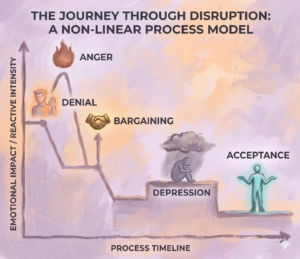
During the announcement of significant change, employees often undergo psychological stages similar to mourning, as described in the Kübler-Ross model—denial, anger, bargaining, depression, and acceptance.
Example:
Imagine a team is told their current ERP system will be replaced by an AI-integrated platform:
- Denial: “This won’t really happen, we’ve heard this before.”
- Anger: “Why would they change something that already works?”
- Bargaining: “Can we at least keep parts of the current system?”
- Depression: “I don’t think I’ll be able to learn this… what’s the point?”
- Acceptance: “Okay, let me start exploring how this works.”
One may not experience these in order, but identifying where you are can help you navigate better and seek support.
Emotional State
Refocus on trust and strength
Managing challenging situations at work often comes down to knowing your strengths and putting them to use your ability to learn, adapt, collaborate, or solve problems under uncertainty.
These are anchors you can lean on.
Research in workplace psychology also shows that resilience is not fixed it can be developed over time through awareness, practice, and supportive environments.
Remember, this is not your first time navigating a challenge. Trust yourself in small ways through the process. Trust is an antidote to anxiety.
If it feels overwhelming at times, that is probably because it is.
And maybe the goal is not to have it all figured out – but to keep showing up, one step at a time.
References
Kübler-Ross, E. (1969). On death and dying. New York, NY: Macmillan.
Jenkins, D. (n.d.). Kübler-Ross change curve. Umbrex. Retrieved from https://umbrex.com
Warwick Business School. (n.d.). Putting the theory into practice: Kübler-Ross change curve. Retrieved from https://www.wbs.ac.uk
Leybourne, S. A. (2016). Emotionally sustainable change: Two frameworks to assist with transition. Journal of Change Management, 16(4), 321–338.
Robertson, I. T., Cooper, C. L., Sarkar, M., & Curran, T. (2015). Resilience training in the workplace: A 12-month follow-up study. Journal of Occupational and Organizational Psychology, 88(3), 533–562.
Resources
https://uca.edu/bewell/files/2020/11/Feelings-Wheel-Learn-How-to-Label-Your-Feelings.pdf
https://orbrick.com/wp-content/uploads/2025/11/OB-Stakeholder-Analysis-v0-2-1.xlsx

Aastha Yagnik is a consulting Psychologist-in-Residence who helps imbue practical psychology across all things Orbrick. She has an MA in Applied Psychology from the Tata Institute of Social Sciences and is passionate about mental health and believes humans have an innate potential for development which must be harnessed, especially in the age of AI.
Stay Ahead with ERP & AI Insights
Actionable insights on ERP, AI and business solutions, straight to your inbox each month.
Subscribe for InsightsRecent Posts





Categories
Latest News

Website Launch And 3 Lessons From Chandrayan-3
January 16, 2024


Real Time Visibility In Supply Chain
January 16, 2024