Picture this. It’s the fifth working day of the new month. The GL Controller is staring at a consistency check that has just failed for the third time. Somewhere in Fixed Assets, depreciation has already been calculated, but Mass Additions hasn’t been run yet, so a batch of capital invoices sitting in Payables never made it into the asset register in time, and depreciation just ran on a book that’s missing assets it should have included. Somewhere in Receivables, multiple unapplied receipts are sitting exactly where they were a week ago. Nobody planned for this. Everybody is now living in it.
This scene plays out in finance teams every single month. And what makes it frustrating is that in most cases, the fix was never really about working harder during close. It was about the sequence, the discipline, and the setup, all of which get decided weeks before close day even arrives.
Here’s a number worth sitting with. More than half of companies still take six or more days to close their books, and yet the overwhelming majority of them believe their timeline is perfectly reasonable. That gap between how long close actually takes and how long people think it takes is where most of the pain quietly lives.
A slow close isn’t just an accounting inconvenience either. Every extra day your books stay open is a day your leadership team is making calls on numbers that could still move. Procurement decisions, headcount approvals, board conversations, all of it happens on data that hasn’t fully settled yet. That’s a decision-making risk wearing an accounting costume.
The good news, and it’s worth saying plainly, is that the Oracle Fusion GL period close process is genuinely well designed when it’s implemented with intention. The problem almost never lives in the software. It lives in how organizations run that software: reactively, as a scramble that starts on close day, instead of as a discipline that runs all month.
The Setup Nobody Revisits
If you’ve read enough of these process breakdowns, you’ll notice a pattern. The biggest mistakes in any Oracle Fusion process rarely happen on the day something breaks. They happen weeks earlier, buried in a configuration decision nobody thought was worth revisiting.
Period close is no exception. Your chart of accounts, your legal entity structure, and your segment inheritance rules quietly decide how painful or painless every single close will be. If that structure was built for an organization half your current size, or inherited wholesale from a legacy system during migration, you are carrying technical debt that adds hours to every cycle, whether anyone has named it that or not.
A few questions worth asking before you touch close day at all:
- Are your segments granular enough to support multi-entity reporting without a manual consolidation step bolted on the side?
- Do your ledger sets reflect how you actually report today, or how a consultant assumed you would report three years ago?
- Is budgetary control enabled at the right level, or are encumbrance balances quietly complicating your subledger closures?
- Has anyone actually reviewed this structure since go-live, or has it just been inherited, quarter after quarter, without question?
And here’s the part that catches people off guard. In Oracle Fusion, each module carries its own period status: Open, Pending Close, or Closed. A period can be closed in Fixed Assets and still wide open in Payables, and your consistency checks will fail precisely because nobody managed that sequence on purpose.
This is worth seeing rather than just reading about, because the mismatch is exactly where most close day surprises come from.
Notice that GL row at the bottom. It cannot move to Closed until every row above it does, and yet in a lot of organizations, nobody is explicitly watching all of those rows at once. For multi-entity organizations especially, this is where you need an actual governance model, not a checklist someone glances at once a month. Someone has to own visibility across every module, across every business unit, at every stage.
Mastering the Close Sequence: The Dependency Web Nobody Documents
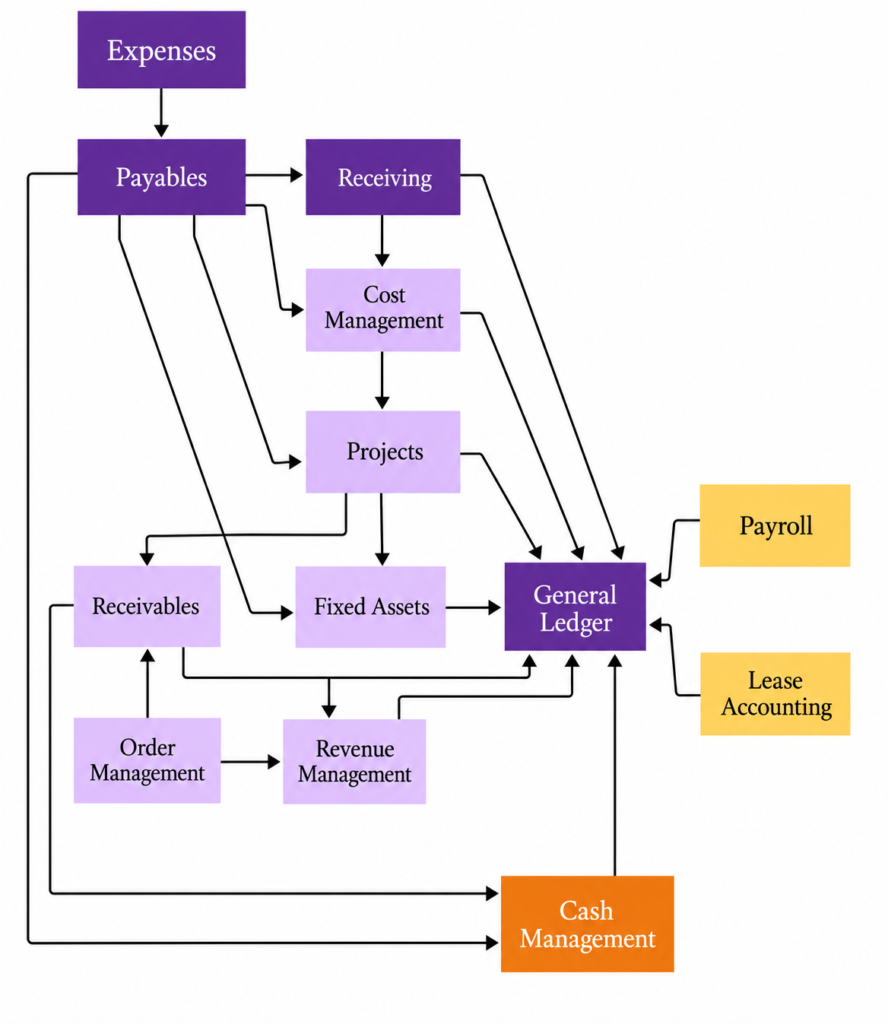
This is the part that separates the teams closing in two days from the teams still closing in eight, and it comes down to one uncomfortable truth: GL close is the last step, not an independent one. It cannot happen properly until every subledger underneath it has been closed in the right order, because data flows downstream. An invoice posted after Cost Management closes doesn’t create a small correction. It creates a reconciliation headache that follows you into next month.
Here’s what that sequence looks like end to end.
(Source: Oracle ERP Cloud Period Close Procedure & Runbook Consideration)
Walking through why each step earns its position:
Intercompany first.
All eliminations and reconciliations need to be resolved before any subledger closes. A discrepancy that surfaces after Receivables is already closed forces a period adjustment, and period adjustments are always more expensive than catching the same issue on day two.
Payables, Fixed Assets, and Projects.
Specifically, Mass Additions needs to have pulled every capitalizable invoice line from Payables into the Fixed Assets register before depreciation runs. Skip that step, and depreciation calculates against an incomplete asset book, quietly understating expense for assets that exist in Payables but haven’t made it into Fixed Assets yet, and nobody notices until Period Close.
Receivables and Projects before Revenue Management.
Revenue recognition depends on what project milestones have genuinely been completed. Close Revenue Management before it is settled, and you’re recognizing revenue against a picture that isn’t finished yet.
GL close last.
Once every subledger shows Closed and Create Accounting has transferred all journal entry data through, you run your final consistency checks and close the GL period. Not before.
I’ve seen organizations try to shortcut this order under deadline pressure, usually with entirely good intentions. It rarely ends the way anyone hoped. The time saved on day one gets paid back with interest during reconciliation, usually by someone who wasn’t in the room when the shortcut was taken.
Also Read: A Hidden Treasure in Oracle Fusion Receivables: Intelligent Cash Application Configuration
When the Delay Isn’t Yours: External and Upstream Dependencies
Not every late close traces back to a gap in your own process. Some of the most persistent delays come from data your team doesn’t control the timing of at all, and it’s worth separating these out explicitly, because the fix for an external dependency is completely different from the fix for an internal one.
Data arriving late from external systems.
Most Oracle Fusion environments aren’t closing in isolation. They’re pulling data through interfaces from external systems, whether that’s a legacy platform or a third-party billing tool. If the source system runs its own month-end processing late, or an interface job fails quietly overnight without anyone noticing until the next morning, that data lands in Oracle after your internal cut-off, and no amount of internal discipline speeds up a system you don’t own.
Government contracts on their own reporting cadence.
This one deserves calling out specifically, because it’s structural rather than accidental. Many government contracts release final cost or billing data only after their own internal review cycle, which frequently lands at or after your period end. This isn’t a vendor being difficult or a process breaking down. It’s a dependency built into the relationship itself, and treating it as a surprise every month is the actual mistake, not the delay.
The right response to both of these isn’t to chase them harder. It’s to isolate them from day one of your close calendar as a known, named exception category, and then get everything else fully staged around them. Every other subledger reconciled, every other sign-off captured, every other consistency check clean, so that the moment the government contract data or the external feed finally lands, you’re one step away from closing rather than five.
Internal provisioning delays.
Not every late input comes from outside the walls. A meaningful share of delays trace back to internal teams simply not submitting cost estimates, provisions, or accrual inputs on time. Sometimes that’s a multi-level approval chain: an accrual needs sign-off from a cost center owner, then a department head, then finance, each with their own informal timeline and none of it tracked centrally. Sometimes it’s a data quality problem: the numbers arrive, but they don’t reconcile, or they’re missing required detail, and now someone has to go back and ask for a correction, which resets the clock on the whole approval chain.
Both of these respond to the same discipline as Phase 1 below: name an owner for each provision, publish a hard date against their name on the close calendar, and escalate before the deadline is missed, not after.
The one report worth watching frequently: Period Close Exceptions.
Oracle Fusion’s Period Close Exception Report exists precisely for this pattern of scattered, hard-to-see blockers. Rather than chasing five different queues to figure out what’s actually holding a module back, this report pulls together the unresolved items across your subledgers in one place: unposted transactions, unreconciled bank statements, pending approvals, and any other open item preventing a module from moving to Closed. Running this frequently during Phase 1, rather than discovering it on close day, is often the single cheapest habit a close team can adopt. It turns “why isn’t this closed yet” from a scramble into a two-minute check.
Close Is a Month-Long Habit, Not a Month-End Event
Here’s something top-performing finance teams understand that everyone else learns the hard way: they don’t close their books at month-end. They spend the entire month preparing so that the actual close is a confirmation exercise, not a race against the calendar. Research on top performing finance organizations consistently finds the same pattern: roughly 80% of close work gets done before the final day of the period even arrives.
That mindset shift is really the whole game, and it maps to four distinct phases spread unevenly across the month.
Phase 1: Pre-close preparation.
This starts on day one and runs continuously, which is exactly why it takes up most of the timeline above. A published closing calendar with hard cut-off dates, named task owners, and clear escalation paths isn’t a nice to have. It’s the thing that keeps late transactions from getting squeezed in where they don’t belong. The calendar isn’t a suggestion; late transactions that miss cut-off get accrued or moved to next period, full stop.
Each subledger owner is quietly doing their part throughout the month. AP is getting invoices matched, approved, and posted, with unmatched receipts resolved rather than left hanging. AR is clearing cash applications and posting credit memos. Fixed Assets is logging additions, disposals, and reclassifications as they happen instead of batching them at month end. Cost Management is transacting every receipt, transfer, and adjustment on an ongoing basis.
A single unapproved expense report sitting in a manager’s queue can hold up the entire Payables close, which is a strange amount of leverage for one overlooked approval to have. That’s exactly the kind of small thing Phase 1 discipline is built to catch early.
Phase 2: Execution and validation.
Before any subledger status moves to Close, run the exception report and make an actual decision on every single line: post it, accrue it, or push it to next period with documentation attached. Don’t move to close with open items still sitting there unresolved.
Set your accrual journal entries to auto-reverse on day one of the next period. This one is not optional, however tempting it is to treat it as a nice to have. Manual reversals get forgotten. Forgotten reversals become prior-period entries. Prior-period entries become audit findings nobody wanted to explain in a meeting.
Phase 3: Review and approval.
Preliminary statements go through departmental variance analysis before anything gets locked down. Every meaningful variance from budget or prior period gets an explanation documented in the system, not buried in someone’s inbox or mentioned once in a meeting and never written down. This is also where your audit trail earns its keep. Oracle Fusion logs who posted what, when, and with what justification.
Final review and Controller sign-off should only happen once every variance explanation is complete. If a number still has a question mark next to it, close hasn’t actually finished, no matter what the calendar says.
Phase 4: Lockdown.
Once the Controller grants approval, each module is closed in the defined sequence, transitioning to Closed status. At this stage, Oracle prevents any further transactions from being posted to the closed period at the application level. For organizations with stringent audit and compliance requirements, the financial period close process can be governed through a controlled business approval mechanism, where reopening a closed accounting period requires authorization from a designated senior approver, ensuring stronger governance, accountability, and compliance.
This additional control introduces intentional friction, safeguarding the integrity of closed financial periods and minimizing the risk of unauthorized changes.
When a Consistency Check Fails, Check These Three Things First
Every AR and GL team eventually hits this moment: a consistency check fails, and the subledger balance doesn’t match the GL control account. Before anyone panics, there’s a sequence worth working through, in order.
First, look for posted transactions in the subledger that haven’t yet transferred through Create Accounting. This is the most common starting point and the easiest to fix once you find it.
Second, check the Create Accounting error log for anything stuck mid-process. Errors here tend to be silent until someone goes looking, which is exactly why this step gets skipped more often than it should.
Third, and this is the one people forget to check, look for manual journal entries posted directly to the control account, bypassing the subledger entirely.
That third one is the most common root cause once you rule out the first two, and it’s also the most preventable. Control accounts in Oracle Fusion can be locked against manual journal entry. If yours aren’t, that’s a configuration fix worth making before your next cycle, not during it, while you’re mid-crisis and everyone is watching the clock.
Before you even reach this troubleshooting sequence, though, the Period Close Exception Report should already have flagged most of this for you. Checking it frequently rather than only when something fails is the difference between debugging a surprise and confirming a known item.
What Prior-Period Adjustments Actually Cost You
It’s worth being direct about what happens when close discipline breaks down and something has to be corrected after the fact. Prior-period entries aren’t just an accounting footnote. They invite auditor questions, and in some cases force other major events, none of which anyone budgeted time for.
The better answer, unglamorous as it is, is prevention. Auto-reversing accruals, disciplined cut-off management, and tight subledger hygiene in Phase 1 eliminate the overwhelming majority of situations that lead to a post-close adjustment in the first place. Every one of those habits is cheaper than the correction it prevents.
What Your Close Process Tells You About Your ERP Maturity
If you’re currently evaluating an ERP or considering an Oracle Fusion upgrade, the period close process is one of the clearest signals of a system’s actual maturity, not its marketing.
Automated versus manual consistency checks.
A system that requires your team to manually reconcile subledger-to-GL balances at period end is not a modern ERP, regardless of what else it does well. Oracle Fusion’s automated Create Accounting process handles that transfer in real time, and the consistency check reports should function as exception reports, not as reconciliation workbooks your team rebuilds from scratch every month. Organizations with high automation typically see close cycles run meaningfully faster than those still relying on manual reconciliation.
Scalability for multi-entity and multi-currency organizations.
Can the system manage period statuses independently across ledgers while still giving you consolidated visibility in one place? For any organization operating across multiple countries or reporting currencies, this isn’t optional. Accounting period definitions, currency conversion rules, and intercompany elimination rules all need to work together automatically, without someone stitching the pieces together by hand every cycle.
Integrated reporting and real-time dashboards.
The entire point of a fast close is faster decisions downstream of it. If your reporting layer requires a separate data export after the GL closes, you’ve already lost the speed advantage you just fought for. Dashboards should refresh in real time as journals post, so leadership can see preliminary results well before final sign-off, not days after.
Audit trail transparency.
Can you see every action taken on every journal entry, including attempts that were rejected? Can a closed period be reopened, and if so, by whom? These questions matter enormously at audit time, and the honest answer should live in the system itself, not in a separate spreadsheet someone maintains on the side.
Oracle Fusion offers a range of powerful AI Agents that streamline data entry, automate routine finance operations, and improve overall process efficiency. By reducing manual effort, enhancing accuracy, and accelerating transaction processing, these AI Agents play a significant role in enabling a faster and more efficient financial period close. Below are some of the most impactful AI Agents that contribute to this objective.
| AI Agent / Capability | Business Benefit |
| Ledger Agent for Agentic AI-Powered General Ledger Experience | Accelerates financial close by proactively identifying, explaining, and resolving accounting exceptions. |
| Payables Agent for Invoice Ingestion, Compliance, and Control | Reduces invoice processing time while improving accuracy, compliance, and straight-through processing. |
| Expenses Agent for Email-Based Expense Completion | Simplifies expense submission through email, reducing manual effort and speeding up reimbursements. |
| Expense Policy Inquiry Enhancements Using Expenses Agent | Improves policy compliance by providing instant AI-powered answers to employee expense policy queries. |
| Cash Processing from Bank Statements and Remittance Advices | Accelerates cash application through automated receipt matching and remittance processing. |
| Retirement Assistant | Streamlines fixed asset retirement by automating validations and reducing manual effort. |
| Expenses Agent for Cash Advance Application | Automates cash advance settlement during expense reporting, reducing reconciliation effort and improving compliance. |
Orbri, our AI, adds validation checks right at journal entry creation across fields and so entries are period-close ready from the start. It gives users clear, real-time visibility into transaction and payment compliance at both entry and approval stages, along with exception visibility at the supplier and supplier-site level. Orbri also guides users step by step with video walkthroughs and highlighted next steps through creating AP invoices and payments, and offers instant insight into open commitments and accrual balances. On top of this, Orbri periodically sends approvers and operators a status update on whether validations are being followed, keeping everyone informed and accountable. Together, these policy-driven checks help teams catch and resolve exceptions early, well before they become a period-close bottleneck.
Habits of High-Performance Accounting Teams
The data on top performers is fairly consistent across studies: organizations that close faster aren’t simply using better software. They’re operating differently, day to day, in ways that are visible if you know what to look for.
This is the continuous close model, and it’s steadily becoming the standard for Oracle Fusion organizations that have actually invested in the automation available to them rather than leaving it configured at default.
They use alerts and exception reports proactively, not reactively. Oracle Fusion can trigger information for unposted transactions, unreconciled bank statements, and journals sitting in approval queues. Top teams configure these to fire throughout the month, not just on close day, so the exception list is already short by the time it matters.
They document their close process in real detail. Roughly half of top-performing accounting organizations document their key processes thoroughly, compared to a meaningfully smaller share of average performers. Documentation isn’t overhead here. It’s what lets a new team member run a sub-process correctly on day one without calling the Controller at nine at night to ask what happens next.
Days to close is treated as a managed KPI, not an afterthought. World-class finance teams target a two-day close, and with current Oracle Fusion capability and well-designed automation, a two-to-three-day close is genuinely achievable today, not some distant aspiration tied to a future product release.
Put together, these habits aren’t separate initiatives. They reinforce each other.
Three Things Your Close Process Is Quietly Telling You
If your period close regularly runs past five days, the honest answer is rarely “we need more people.” It’s almost always one of three root causes, and they’re worth naming plainly rather than treating as a vague sense that things are slow.
None of these are particularly hard to fix on their own. They just require someone to own the close as an actual process, with a documented sequence and a real governance model, rather than treating it as a calendar event that happens to everyone at once and gets survived rather than managed.
The teams that close in two to three days aren’t necessarily working with fundamentally different software than everyone else. They’re working with the same Oracle Fusion capability, configured with intention, and reviewed continuously throughout the month instead of discovered all at once on the last day of it. That’s really the whole difference between the team still scrambling on day eight and the team that finished on day three and moved on. And it’s a solvable one.

Bhumish Padshah is an experienced Chartered Accountant and Sr. principal specialist with an exhibited history of working in Oracle Consulting and Statutory Audit. He enjoys traveling, cricket and reading apart from work.
Rutangshi Thakkar is a Chartered Accountant and Associate Consultant in Finance, she is passionate about simplifying complex Oracle Cloud concepts into practical business insights. Outside of work, she enjoys watching crime and suspense movies, traveling, exploring local street food, and spending time with her family and close friends.
Stay Ahead with ERP & AI Insights
Actionable insights on ERP, AI and business solutions, straight to your inbox each month.
Subscribe for InsightsRecent Posts




Categories
Latest News

Website Launch And 3 Lessons From Chandrayan-3
January 16, 2024


Real Time Visibility In Supply Chain
January 16, 2024